A Bedtime Story That Helps Kids Deal With Anxiety
Anxiety doesn’t wait for morning. It shows up at bedtime, when the lights go off and a child’s mind has nowhere to hide. But the right story can meet it there.
“What if the last thing your child hears before sleep isn’t ‘stop worrying’ — but a story that teaches their brain how?”
By the Fable Jar Team ·

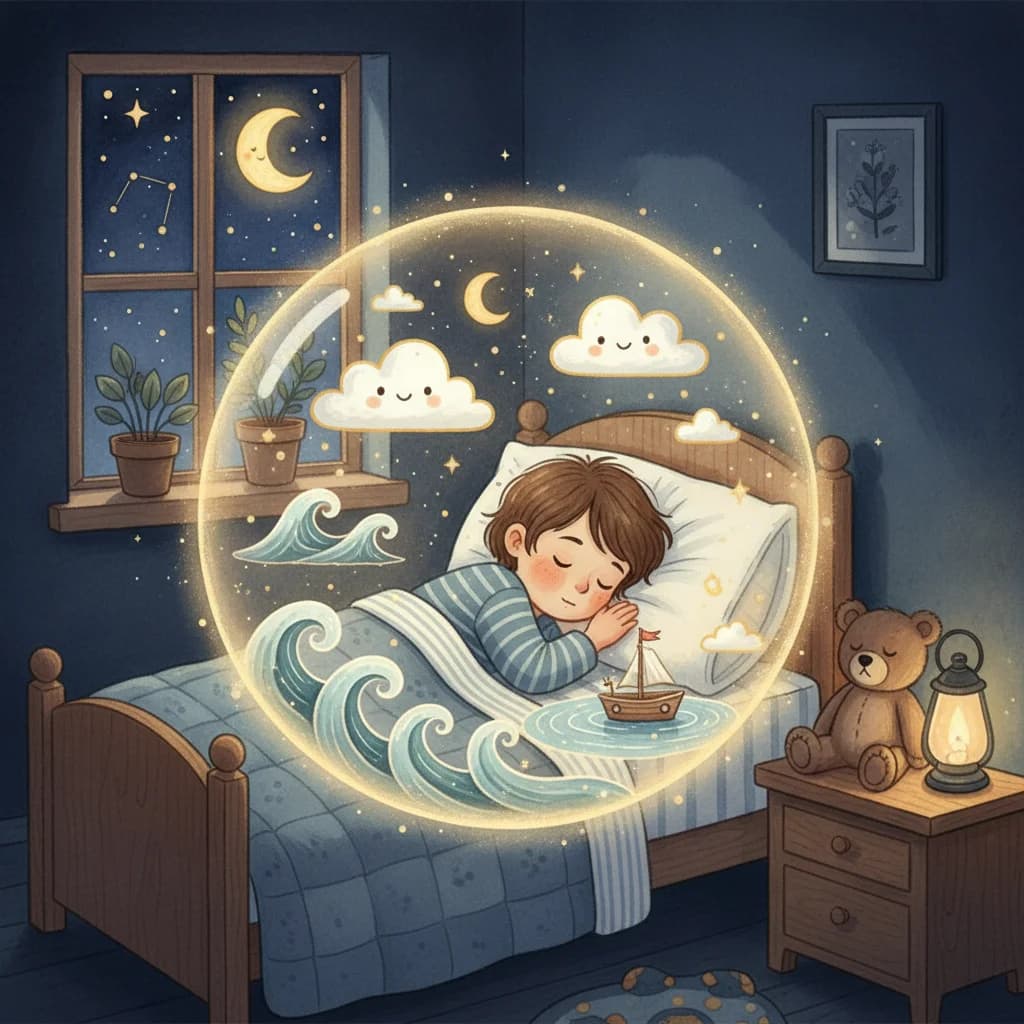
Your child is in bed. Teeth brushed, pajamas on, blanket tucked just right. Everything is quiet. And then it starts. “What if I can’t fall asleep?” “What if something bad happens tomorrow?” “What if you forget to pick me up?” The questions come one after another, quiet and relentless, like waves on a shore that won’t recede.
You answer each one. You reassure. You soothe. You explain, again, that nothing bad is going to happen. But here’s the thing about childhood anxiety: it doesn’t respond to answers. It responds to feelings. And right now, at bedtime, in the dark, your child’s feelings are louder than any words you can offer.
If this is your child — or even a version of your child on some nights — you’re not alone. And the solution isn’t more reassurance. It’s a different kind of conversation entirely. One that doesn’t happen through words. It happens through story.
Anxiety doesn’t listen to logic. It listens to experience. And a story, told well, is an experience the brain can’t distinguish from the real thing.
Childhood anxiety is more common than you think
Anxiety is the most common mental health challenge in children. According to the CDC, approximately 9.4% of children aged 3–17 — nearly 5.8 million kids — have been diagnosed with an anxiety disorder. And that’s only the diagnosed cases. Many more children experience anxiety that never reaches a clinical threshold but still disrupts their sleep, their confidence, and their daily life.
The numbers have been climbing steadily since 2016, with post-pandemic data showing a particularly sharp increase. But here’s what the statistics don’t capture: the everyday, low-grade worry that millions of children carry to bed every night. The child who isn’t “anxious” enough for a diagnosis but still can’t turn their brain off. The child who seems fine during the day but unravels at bedtime.
That child doesn’t need therapy (though therapy is wonderful). They need a nightly tool. Something that meets their worry exactly where and when it shows up — and gives their brain something to do with it besides spin.
Why bedtime makes everything feel bigger
There’s a reason your child’s worries peak at night. During the day, the brain is busy — processing stimuli, solving problems, navigating social situations. There’s no spare bandwidth for worry. But at bedtime, the external world goes quiet, and the brain turns inward. It starts reviewing. Replaying. Anticipating. And without anything to distract it, the mind’s threat-detection system — the amygdala — fills the silence with warnings.
For adults, this manifests as the classic “3am thought spiral.” For children, whose prefrontal cortex is still developing and can’t regulate these intrusive thoughts, it’s even more overwhelming. They don’t have the cognitive tools to say “That’s just my brain being anxious.” To them, every worry feels like a prediction. Every “what if” feels like a “what will.”
This is why reassurance doesn’t stick. When you say “Everything will be fine,” your child’s logical brain might register the words. But their emotional brain — the one running the show at bedtime — is already deep in a story of its own. A scary one. The only way to interrupt that story is to replace it with a better one.
At bedtime, a child’s brain is already telling itself a story. The question isn’t whether they’ll hear one. It’s whether you get to choose which one.
Narrative therapy: giving anxiety a shape
In the 1980s, family therapists Michael White and David Epston developed an approach called narrative therapy, built on a disarmingly simple idea: the stories we tell about ourselves shape how we experience our lives. Change the story and you change the experience.
One of their most powerful techniques is externalization — the practice of separating a person from their problem by turning the problem into a character. Instead of saying “I am anxious,” a child learns to say “The Worry Monster is visiting.” Instead of “I can’t stop thinking about it,” they say “The Worry Monster won’t be quiet tonight.”
This sounds small. It is enormous. When anxiety is part of who you are, it’s inescapable. When anxiety is a character who shows up — a visitor, a creature, a cloud — it becomes something you can observe, talk to, negotiate with, and eventually send away. Externalization gives children power over something that otherwise has power over them.
And here’s where bedtime stories become therapeutic gold. A story is the perfect delivery system for externalization. You can give anxiety a name, a face, a voice. You can show it arriving, being acknowledged, and then being gently managed — not defeated with force, but understood and soothed. The child watches a version of themselves handle the Worry Monster with curiosity instead of terror. And their brain files that experience away as a template for the next time worry shows up.
How externalization works in stories
Give It a Name
The Worry Cloud. The Fizz Monster. The What-If Bug. When anxiety has a character, it stops being part of the child’s identity and becomes something separate they can observe and manage.
Meet It with Curiosity
In the story, the hero doesn’t fight anxiety — they notice it, name it, and talk to it. This mirrors what therapists teach: the goal isn’t to eliminate worry, but to change your relationship with it.
Shrink It with Bravery
Each time the character acknowledges the worry without obeying it, the creature gets smaller. This teaches children that attention is the currency of anxiety: stop feeding it fear, and it loses power.
6 ways to ease anxious bedtimes tonight
You don’t need to be a therapist to help your child manage bedtime anxiety. These strategies are grounded in the same principles therapists use — adapted for parents, for bedtime, for tonight:
Name it to tame it
Help your child give their worry a character. Ask: “If your worry was a creature, what would it look like? Is it big or small? What colour is it?” Once they can describe it, they’ve already created distance from it. They’re observing it, not drowning in it.
Validate, don’t dismiss
Resist the urge to say “Don’t worry” or “There’s nothing to be scared of.” Instead try: “I can see your worry is being really loud tonight. That’s hard. I’m right here.” Validation reduces the amygdala’s alarm response. Dismissal amplifies it.
Create a “worry time” earlier in the evening
Give your child 5–10 minutes before the bedtime routine to say all their worries out loud. Write them down, fold the paper, and put it in a “worry box.” Tell them: “The box is holding your worries now. Your brain can let go.” This externalizes worry before bedtime even begins.
Teach the slow exhale
Anxiety speeds up the breath. A slow exhale reverses this. Have your child breathe in for four counts, then out for six. The longer exhale activates the parasympathetic nervous system — the body’s “safe” signal. Make it playful: pretend they’re blowing out birthday candles one at a time.
Tell a story where the hero manages worry
This is the most powerful tool in your bedtime kit. A story where a character — ideally one who shares your child’s name — meets their worry, names it, and learns to quiet it. The story doesn’t banish the worry. It teaches the child that worry is manageable. That they are bigger than their biggest fear.
Close with an anchor thought
After the story, give your child one sentence to hold onto as they fall asleep. Something simple and true: “You are safe. You are loved. You are brave enough.” Repetition builds neural grooves. Over time, this thought will surface automatically when worry arrives.
What a story designed for anxious bedtimes looks like
The strategies above are things you can do tonight with nothing but your voice and your presence. But if you want a story that’s been specifically shaped to help an anxious child — one that externalizes worry, models calm, and ends with your child feeling safe and capable — that’s exactly what Fable Jar builds.
You tell us your child’s name, age, and what they’re worried about. In under a minute, we create a story where they meet their worry as a character, learn to understand it, and discover they have the power to quiet it — not with force, but with breath, and courage, and the kind of calm that only comes from knowing you’ve handled this before.
Sam and the Fizz Monster
Sam could feel it again — that fizzy, buzzy feeling in his tummy, like someone had shaken a bottle of lemonade inside him. It always came at bedtime. It made his thoughts go fast and his heart go faster.
“What if I can’t sleep?” he whispered to the dark. “What if tomorrow goes wrong?”
Then he heard it. A small pop, like a bubble bursting. And there, sitting on the end of his bed, was a round, fuzzy creature covered in tiny fizzing bubbles. It had enormous eyes and a mouth that wouldn’t stop chattering. “What if what if what if what if,” it muttered, bouncing slightly with each word.
“You’re the Fizz Monster,” said Sam. He wasn’t scared. Surprised, yes. But the creature looked more nervous than dangerous.
“I am,” said the Fizz Monster, looking embarrassed. “I can’t help it. I get bigger every time you listen to me.”
Sam thought about this. “What if I don’t listen?” The Fizz Monster blinked. “Then I get smaller.” So Sam took a deep breath. He breathed out slowly, like blowing on a dandelion. And with each breath, the Fizz Monster shrank — a little smaller, a little quieter — until it was no bigger than a marble, humming softly on the pillow. “You can stay,” Sam whispered. “But I’m in charge.”
Create a story like this for your child →Give your child a tool for anxious bedtimes
Tell us their name, age, and what they worry about. Fable Jar creates a personalized story where they learn to manage their anxiety — as the hero.
Create a Story for Your ChildTakes less than 60 seconds. First story is free.
Imagine tonight. The lights are off. The worries start. But instead of spiraling, your child remembers a story. A story where they met the Fizz Monster, and they took a deep breath, and they made it shrink. They close their eyes and try it. Breathe in. Breathe out. And somewhere in the quiet, the fizzing slows. The worry gets smaller. And your child — your brave, anxious, beautiful child — falls asleep knowing they are bigger than their biggest fear.
What parents of anxious children are saying
“My daughter used to take 45 minutes to fall asleep because her mind wouldn’t stop. After her Fable Jar story about the Worry Cloud, she started doing the breathing on her own. Last night she was asleep in twelve minutes. I sat outside her door and cried.”
“My son calls his anxiety ‘the Fizz’ now. When it shows up, he says ‘It’s just the Fizz, Dad. I know what to do.’ That sentence is worth more than anything I’ve ever bought him.”
Get weekly tips for calming anxious bedtimes
One email a week. Practical strategies for worry, fear, and sleep. No spam.
Join 5,000+ parents. Unsubscribe anytime.
Keep reading
What to Do When Your Child Is Afraid of the Dark
Telling them “there’s nothing there” doesn’t work. Here’s what does — and how a story can reframe the dark.
The Science Behind Why Personalized Stories Build Real Confidence
When a child is the hero of a story, something shifts in their brain. Here’s what the research says.
Why Bedtime Stories Are More Important Than You Think
They’re not just entertainment. They’re quietly shaping your child’s brain, their emotional world, and your bond.