How Stories Shape a Child’s Thinking
Children don’t learn values from lectures. They absorb them from characters they love — especially when that character is themselves.
“The stories your child hears become the voice inside their head.”
By the Fable Jar Team ·

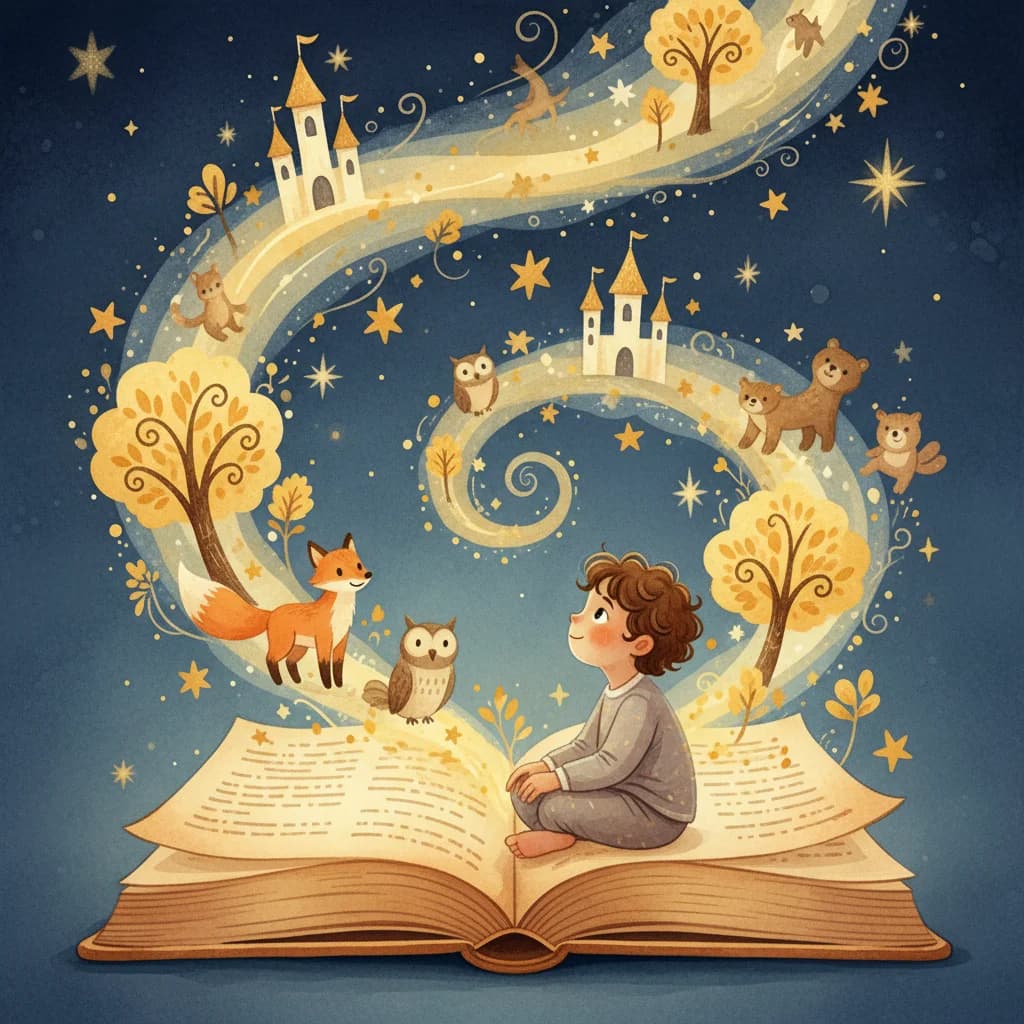
Your child takes a toy from their sibling. You step in. You say the words every parent has said a thousand times: “That’s not kind. We share. How would you feel if someone took your toy?” Your child nods. Maybe they even say sorry. And then, twenty minutes later, they do it again.
You’re not failing. The words aren’t wrong. But something about the way children’s brains process values means that telling them what’s right almost never works as well as showing them. And the most powerful way to show them isn’t through your own example — it’s through a story.
This isn’t a new idea. Humans have been teaching values through stories for as long as we’ve had language. What’s new is our understanding of why it works — and how you can use it deliberately, every night, to shape the way your child thinks about kindness, honesty, courage, and everything else that matters.
A child who hears “be kind” knows the rule. A child who watches a character choose kindness understands the reason.
The science of narrative transportation
In the early 2000s, psychologists Melanie Green and Timothy Brock coined the term “narrative transportation” — the phenomenon where a person becomes so absorbed in a story that they psychologically “enter” the narrative world. When this happens, something remarkable occurs: the listener’s beliefs, attitudes, and values shift to align with those of the story.
It’s not persuasion. It’s not argument. It’s something deeper. When a child is transported into a story, their critical defenses — the part of the brain that says “You’re not the boss of me” — go quiet. They stop evaluating and start experiencing. The story’s values don’t enter through the front door of logic. They slip in through the side door of emotion.
This is why Aesop’s fables have survived for two thousand years. Not because someone forced children to memorize the morals. Because the stories were good enough to transport children into a world where kindness, cleverness, and patience were rewarded — and the children came out the other side believing in those things a little more deeply.
How stories build moral reasoning (not just moral knowledge)
There’s an important distinction between knowing what’s right and understanding why it’s right. Most children, by age four or five, can recite the rules: share, be kind, don’t hit, say sorry. They know the answers. But moral reasoning — the ability to weigh competing needs, see another’s perspective, and choose the harder right over the easier wrong — is a different skill entirely.
And it develops almost entirely through experience. Your child needs to encounter situations where kindness is complicated, where honesty is hard, where the right thing isn’t obvious. They need to see characters wrestle with dilemmas and make choices — sometimes good, sometimes imperfect — and feel the emotional weight of those choices.
Stories are the safest, richest laboratory for this kind of learning. In a story, a child can watch a character choose to share when they don’t want to, and feel both the difficulty and the reward. They can see what happens when a character lies, and feel the discomfort of the consequence without living it themselves. Every story is a moral simulation.
Research from Harvard’s Graduate School of Education confirms this: children who are regularly exposed to rich narrative fiction score significantly higher on measures of empathy and moral reasoning than children who aren’t. Not because they’ve been lectured. Because they’ve practiced.
Every story is a moral simulation. Children don’t just hear what the character did — they feel why, and they carry that feeling into their own choices.
The difference between telling and showing
Let’s say your child has been excluding a classmate. You could say: “You need to include everyone. It’s not nice to leave people out.” This is a clear instruction. It’s correct. And for most children, it slides right off.
Or you could read them a story. In this story, there’s a character — someone their age, maybe someone a lot like them — who notices a new kid sitting alone. The character feels uncertain. They want to play with their existing friends. But something nudges them to walk over. They say hello. It’s awkward at first. Then it’s not. By the end of the story, the new kid becomes part of the group, and everyone’s world is a little bigger.
Your child didn’t receive an instruction. They received an experience. They felt the character’s hesitation, their choice, and the warmth of the outcome. And tomorrow at school, when they see a kid sitting alone, they won’t be recalling a rule. They’ll be recalling a feeling.
That’s the difference. Rules live in short-term memory. Feelings live in the self.
How stories shape values vs. how lectures do
Lectures Deliver Rules
“Don’t lie.” “Be kind.” “Share your toys.” Children hear the words, but without emotional context, the rules remain abstract and easily forgotten.
Stories Deliver Understanding
A character who chooses honesty when it’s hard — and feels both the fear and the relief — gives the child an emotional blueprint for why honesty matters.
Personalized Stories Deliver Identity
When the character is <em>your child</em>, the story goes even deeper. It doesn’t just show them what to do. It shows them who they already are — someone kind, brave, and thoughtful.
Why personalized stories make this even more powerful
Everything above is true for stories in general — picture books, fairy tales, stories you make up on the spot. But something extraordinary happens when the hero of the story is your child.
When children hear their own name in a narrative, the brain’s self-referential processing network lights up. This is the same network that constructs their identity — their sense of who they are. The story’s values don’t land as advice. They land as self-knowledge. The child doesn’t think “That character was kind.” They think “I was kind.”
And when this happens at bedtime — during the window of receptivity, when the brain is filing away the day’s most important experiences — the effect is amplified. The story becomes part of the child’s internal narrative. Part of the voice in their head. Part of who they believe they are.
Noah and the Two Paths
Noah found the crossroads at the edge of the Whispering Woods. One path was wide and golden, lined with candy trees and laughing streams. The other was narrow and dim, and at the end of it, someone was crying.
“The golden path is for me,” said the fox, already trotting toward the candy trees. “Why would anyone choose the hard one?”
Noah looked at the golden path. He looked at the narrow one. He thought about the crying. And then he did something the fox didn’t expect — he turned toward the sound that needed him.
At the end of the narrow path sat a small hedgehog with a thorn in its paw. Noah knelt down and, very gently, pulled it free. The hedgehog looked up at him with bright, grateful eyes. “You chose the harder path,” it said softly. “That’s how you know it was the right one.”
Create a story like this for your child →How to use stories to shape your child’s values
Don’t state the moral — let them find it
Resist the urge to say “See? The lesson is…” Children internalize values more deeply when they discover them on their own. After the story, ask: “Why do you think Noah chose that path?” Their answer will tell you more than you expect.
Show the cost, not just the reward
The best moral stories don’t make the right choice easy. They make it hard — and worth it. When a character gives up something to do the right thing, children learn that values have weight, and that makes them more real.
Use real challenges, not abstract ones
A story about sharing toys lands harder than a story about sharing treasure. The closer the story is to your child’s actual world — their school, their sibling, their friend group — the more the lesson transfers to real life.
Read it more than once
Repetition isn’t just for toddlers. When a child asks for the same story again, their brain is deepening the neural pathways the story created. Each reading strengthens the association between the value and the emotion. Let them ask for it again.
Make your child the hero
The single most powerful thing you can do is put your child in the story. When the hero who chooses kindness has your child’s name, the brain doesn’t file it as a lesson. It files it as identity.
Give your child a story that shapes who they become
Tell us their name, age, and the value you want to nurture. Fable Jar creates a personalized story where they discover it for themselves.
Create a Story for Your ChildTakes less than 60 seconds. First story is free.
Twenty years from now, your child won’t remember the rules you told them. But they’ll remember the stories. They’ll remember the characters who chose kindness when it was hard, who told the truth when it was scary, who helped when no one was watching. And if those characters had their name — those stories won’t just be memories. They’ll be the foundation of who they are.
What parents are noticing
“My son heard a story about his character choosing to include a new kid. The next week, he came home and told me he’d invited the new boy in class to sit with him at lunch. He said, “It’s what I do in my stories.””
“My daughter used to melt down when things didn’t go her way. After a few weeks of stories about patience and flexibility, she’s still a firecracker — but now she pauses. She breathes. Something shifted.”
Get weekly insights on raising thoughtful kids
One email a week. Practical parenting insights. Story-based solutions. No spam.
Join 5,000+ parents. Unsubscribe anytime.
Keep reading
Why Stories Work Better Than Advice for Children
When you tell a child what to do, they resist. When a story shows them, they absorb it. Here’s the psychology behind it.
A Simple Way to Build Confidence in Kids Every Night
Confidence is built in small, repeated moments — like hearing yourself succeed in a story, night after night.
Why Bedtime Stories Are More Important Than You Think
They’re not just entertainment. They’re quietly shaping your child’s brain, their emotional world, and your bond.